
StatsCan Confirms Sharp Drop in Canadian Travel to U.S. — Again — as Overseas Demand Climbs
April 15, 2026 Billy Walker
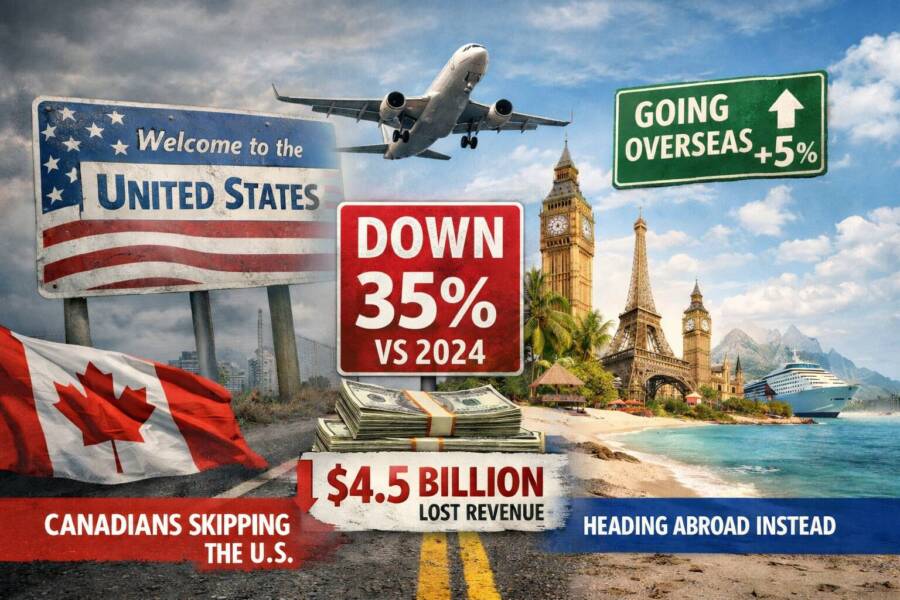
New federal data underscores a major shift in Canadian travel patterns, with fewer trips south of the border 35% versus March 2024, roughly $4.5 billion in lost visitor spending.
New data from Statistics Canada, combined with industry tracking, confirms what many have been seeing play out in real time: Canadians are continuing to pull back from the United States — and redirecting those travel dollars elsewhere.
March numbers tell the story.
The number of Canadians driving into the U.S. — traditionally the backbone of cross-border travel — fell 5% compared to March 2025, and is now down a staggering 35% versus March 2024. Air travel isn’t immune either, dropping 14% year over year.
For the third straight month, more Canadians flew overseas than drove to the U.S. That’s a major break from long-standing travel habits. Overseas travel rose 5% in March, reinforcing a trend that’s been building: Canadians aren’t cancelling trips — they’re simply choosing different destinations.
Europe, sun markets beyond the U.S., and long-haul experiences are picking up the share.
At the same time, cross-border traffic is tilting the other way. Americans visiting Canada were up 4% in March, creating an increasingly one-sided flow between the two countries.
A recent study from Longwoods International found that 23% of Canadian travellers have cancelled a planned trip to the United States. As CEO Amir Eylon put it: “In my 37 years in the travel industry, I have never seen anything like what the Canadians have pulled off.”
That’s not just a dip — that’s behavioural change.
Canadian travellers have long been the largest source of international visitors to the U.S., accounting for roughly a quarter of all inbound travel. In 2024 alone, they contributed $20.5 billion to the U.S. economy. Industry estimates warned that even a 10% drop could cost $2.1 billion and 140,000 hospitality jobs.
Instead, the decline has reached 22% — translating into roughly $4.5 billion in lost visitor spending.
And it’s not slowing down. The downturn carried into 2026 with double-digit declines in January and February, and cumulative two-year drops exceeding 30% each month.
Some will recall the “Trump Slump” of 2017. But this version appears deeper. While global tourism rebounded in 2025, the U.S. stood out as one of the few markets to see inbound visitor spending decline, with a 6.3% drop tied to a mix of tariffs, “America First” rhetoric, and tighter immigration policies.
The U.S., long a reliable favourite, is no longer the default. In its place, long-haul demand is rising, opening the door to higher-value bookings and more diverse itineraries.
Canadians aren’t travelling less.
They’re just choosing to go somewhere else.
About the Author