
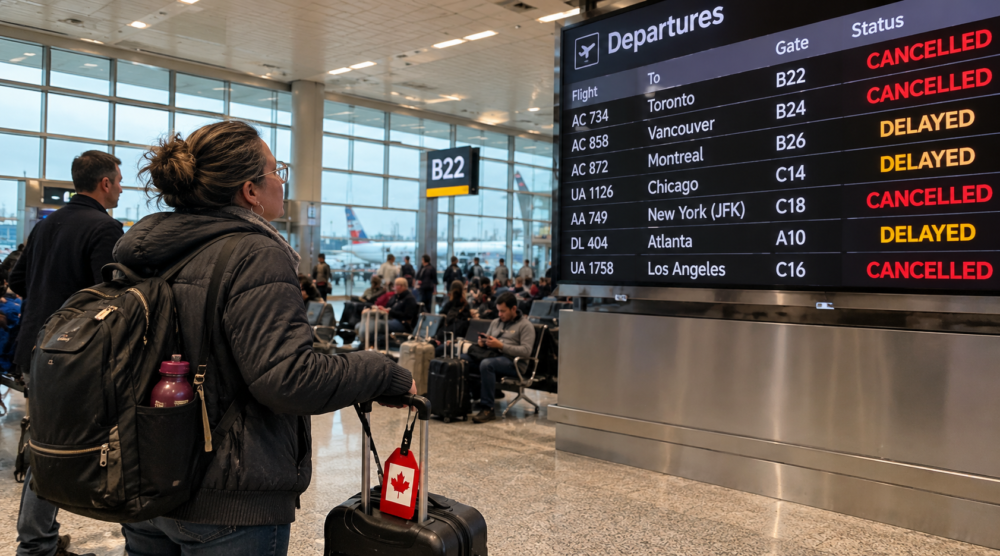
FAA US Grounded Flights Can Now Fly, But Expect Delays and Cancellations to Continue
November 14, 2026 Team Contributor
The FAA has lifted its nationwide flight ground stop following a major air traffic communications failure. Thousands of cancellations and delays have disrupted travel, including flights between Canada and the US. Here’s what happened and what passengers need to know.
Thousands of travellers were caught off guard on Friday, November 13, after the US Federal Aviation Administration (FAA) ordered a nationwide ground stop, temporarily halting departing flights at airports across the country.
The order followed a telecommunications outage that affected the FAA’s air traffic control network. The event is massive, with estimates suggesting some 1.5 million people stranded by the cancellations. It lasted for almost 5 hours.
With plans disrupted, hapless passengers are trying every option. The problem is there aren’t many. Long queues, few car rentals available, and even travelers are ready to take usually long trips of 18-19 hours. Some are exhausted and looking to stay at a hotel.
For some stranded passengers, getting home meant relying on complete strangers. At Atlanta’s Hartsfield-Jackson Airport, Frankie Cistaro offered to share his car with another traveller, David, who was also trying to reach Indianapolis.
A visibly frustrated Secretary of Transportation Sean Duffy blamed old air traffic control technology for the US ground stop. He said older switches and routers, operating alongside legacy analogue telecommunications equipment, are becoming a liability.
Domestic US flights are taking off again, but the fiasco will continue to plague airline schedules, with further delays and cancellations expected on Saturday, November 14, as Thanksgiving travel approaches in a couple of weeks. As many as 2,000 flights are cancelled today, and around 300 flights will be delayed.
The disruption has also crossed the border, affecting Canadian airports, US-bound passengers and some international routes. We bring you the details.
Why were planes grounded across the US?
The FAA grounded US flights after it detected a communication issue across its 22 Air Route Traffic Control Centers. These facilities coordinate aircraft travelling between airports across the US. These are the nerve centres that make communication reliable and safe. With the radar and communications systems malfunctioning, the FAA took the call.
As a precaution, the FAA instructed airports nationwide to hold departing traffic until further notice. International arrivals were to be handled on a case-by-case basis, while aircraft already airborne were allowed to continue to their destinations.
Did a cyberattack cause the nationwide flight grounding? Authorities have ruled out the massive Microsoft outage or an external threat as the cause, despite cyberattack concerns quickly gaining traction online. US Homeland Security Secretary Markwayne Mullin said there was no indication that the communications failure was a deliberate attack or a broader security threat.
Are US flights still grounded? Has the FAA lifted the restriction?
Yes, the nationwide ground stop has been lifted. The FAA allowed normal departures to resume on Friday evening, November 13, after more than four hours of disruption.
However, this does not mean every affected flight is back on schedule.
Airlines need to reposition aircraft, bring crews back into place and clear the backlog of stranded passengers. Flight-tracking figures cited by ABC News showed nearly 5,000 cancellations across the US on Friday evening, with thousands of other flights delayed.
Further disruption is possible on Saturday, particularly for passengers connecting through busy US airports.
Travellers should check the FAA’s National Airspace System Status for airport-level restrictions and their airline’s flight-status page for individual updates.
How are Canadian airports and Air Canada flights affected?
Although Canada’s air traffic control infrastructure was not directly affected, the US disruption created significant knock-on problems for Canadian aviation.
NAV CANADA said its systems were operating normally, but it introduced traffic-management measures at Toronto Pearson, Montréal-Trudeau, Calgary and Vancouver to manage changing traffic volumes.
Toronto Pearson (YYZ): Flights between Pearson and the US were affected, with several departures and arrivals delayed or cancelled. At one point, the airport reported no scheduled US-bound departures or arrivals. Travellers were advised to check directly with their airlines before leaving for the airport.
Vancouver International Airport (YVR): YVR reported delays to US-bound departures and some international flights that needed to fly over US airspace. The airport initially said domestic flights within Canada were not directly affected.
Air Canada: The airline announced that it had cancelled all remaining flights between Canada and the US for Friday evening. Flights between Canada, the Caribbean and South America that needed to transit US airspace could also be affected.
Even passengers travelling domestically within Canada or on other international routes should check their flight status. Aircraft and crew displaced by the ground stop can create further schedule changes.
What should affected Canadian travellers do?
If you are travelling to or from the US, or connecting through a US airport, take these steps:
- Check before leaving: Verify your flight status through the airline’s website or app. A lifted ground stop does not guarantee that your particular flight will operate.
- Check connecting flights: Even when your first flight is operating, a delayed incoming aircraft or disrupted onward connection can affect your itinerary.
- Use online rebooking: Check whether your airline has automatically rebooked you before joining customer service queues.
- Keep your records: Save cancellation notifications, boarding passes and receipts for any additional expenses.
Canadian passengers are also protected by the Air Passenger Protection Regulations (APPR). For disruptions outside an airline’s control, airlines still have rebooking obligations. If they cannot arrange travel on their own or a partner airline’s next available flight within 48 hours of the original departure time, passengers must be offered a choice between a refund and alternative rebooking.
Cash compensation is generally not payable for disruptions outside the airline’s control.
Read the Canadian Transportation Agency’s passenger protection rules for details.
Is Amtrak also experiencing an outage?
Amtrak also attracted attention as stranded air passengers looked for alternative ways to travel.
The rail operator experienced reports of website and app booking errors, alongside unusually high customer-service call volumes. However, Amtrak said its train services were operating normally and that it was seeing increased demand across its network.
In other words, the reported problem concerned booking access and customer-service pressure, not a nationwide suspension of passenger train operations.
Passengers considering rail travel can check Amtrak’s official service alerts.
The FAA’s nationwide ground stop is over, but the disruption has not disappeared from airline schedules.
About the Author