
Sargassum Is Changing Beach Vacations in Mexico and the Caribbean. Here’s What Travellers Need to Know
November 10, 2026 John Kirk
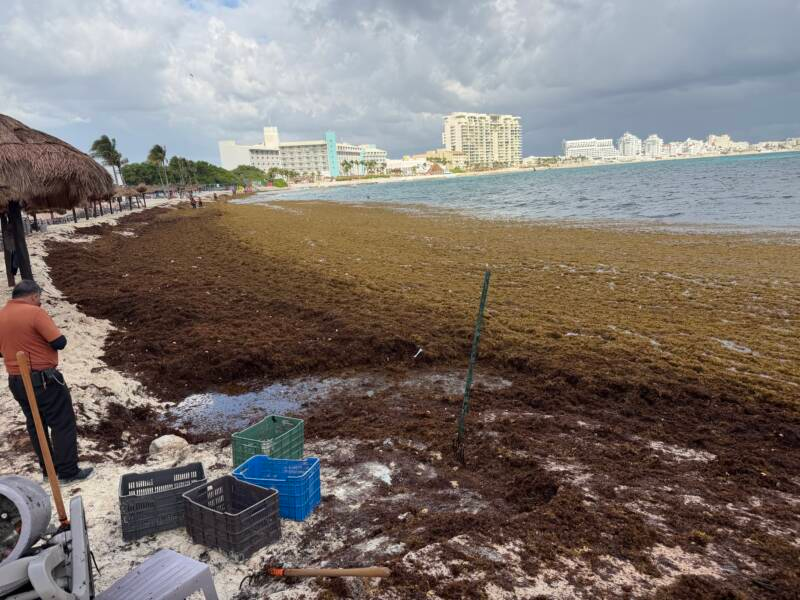
Massive quantities of seaweed are washing ashore in Mexico and parts of the Caribbean, creating an expensive headache for resorts and an unpleasant surprise for vacationers. But not every beach is affected, and geography makes a big difference.
There’s nothing quite like arriving at a Caribbean resort, heading straight for the beach and seeing that spectacular stretch of white sand and turquoise water you’ve been dreaming about for months.
Unless, of course, the beach is covered in brown seaweed.
That’s becoming an increasingly familiar sight along parts of Mexico’s Caribbean coastline and elsewhere in the region, where enormous quantities of sargassum are creating headaches for tourists, resort operators and local communities.
The impact of sargassum can change remarkably quickly, sometimes within just a few days. A beach that is pristine one morning can be covered in seaweed the next, depending on ocean currents, wind direction and weather conditions. Equally, a heavily affected beach can clear up surprisingly fast as tides shift or resort cleanup crews move in. That’s why travellers shouldn’t assume that reports or photos from even a week earlier reflect current conditions. Sargassum is highly unpredictable, and conditions can vary dramatically between neighbouring beaches, even on the same island.

But don’t let sargassum spoil your vacation. (Trying not to be too ” Saragastic ” here) There’s much more to a Caribbean or Mexican vacation than the beach. Explore local attractions, book an excursion, discover the culture, enjoy the resort pools, play some golf, savour the food and, most importantly, make the most of time with family and friends. A little seaweed doesn’t have to ruin a great holiday. Take it in stride, adjust your plans if necessary and remember, you’re still on vacation in one of the most beautiful parts of the world.
And while the problem isn’t new, the scale of it has become difficult to ignore.
Travel filmmaker Evan Edinger takes a fascinating look at the phenomenon in his YouTube documentary, Mexico’s Beaches Have a Problem Money Can’t Fix. It’s an eye-opening examination of an environmental issue that has become a serious challenge for one of the world’s most popular vacation regions. Link to his video below.
The title pretty much sums up the dilemma. Resorts can spend enormous amounts of money cleaning their beaches, but they can’t stop the ocean from delivering another load of seaweed tomorrow.
✉ SHARE THIS ARTICLE BY EMAILWhat Exactly Is Sargassum?
Sargassum is a naturally occurring brown seaweed that floats on the ocean’s surface, often forming enormous mats that can stretch for kilometres.
In the open ocean, it’s actually a good thing.
The floating vegetation provides food, shelter and breeding habitat for fish, sea turtles and other marine creatures. It’s an important part of the Atlantic marine ecosystem.
The trouble starts when large quantities wash ashore.
As the seaweed accumulates and decomposes, it can turn beautiful beaches into unpleasant stretches of rotting vegetation, complete with the distinctive smell of rotten eggs.
That odour comes from hydrogen sulphide, a gas released during decomposition. In sufficiently high concentrations, it can cause irritation and other health concerns.
The seaweed can also make swimming difficult, affect coastal water quality and interfere with marine ecosystems.
For resorts that sell the promise of pristine beaches, that’s a significant problem.

An Ocean-Wide Problem
One of the most interesting aspects of Edinger’s documentary is the sheer scale of the phenomenon.
This isn’t simply seaweed growing offshore and drifting onto a few beaches.
Since 2011, scientists have documented recurring massive accumulations of sargassum across the tropical Atlantic, forming what researchers call the Great Atlantic Sargassum Belt.
Satellite imagery has revealed an extraordinary ribbon of floating vegetation stretching across the ocean from waters near West Africa toward the Caribbean and Gulf of Mexico.
The University of South Florida’s Optical Oceanography Laboratory has been monitoring these blooms for years, using satellite observations to estimate their size and movement.
And the numbers are staggering.
In May 2025, researchers estimated approximately 38 million metric tonnes of sargassum across the tropical Atlantic, a record for that month. The following year, June 2026 brought another exceptionally large bloom, with NASA reporting the second-largest June total in the satellite record.
Those figures represent floating sargassum across a vast ocean region, not the amount deposited on beaches.
But even a relatively small portion reaching popular resort coastlines can create an enormous cleanup challenge.
Why Is There So Much of It?
That’s the million-dollar question, and one scientists are still working to answer.
Edinger’s video explores the environmental conditions behind the growth of sargassum and the difficulty of addressing a problem that originates far beyond the beaches where it eventually arrives.
Researchers have examined the role of ocean currents, changing wind patterns, water temperatures and nutrients entering the Atlantic.
Nutrient-rich water from major river systems, including the Amazon, may contribute to growth under certain conditions. Scientists have also investigated the possible influence of agricultural runoff and other sources of nutrients.
Climate variability is another important part of the discussion.
But there’s no single, universally accepted explanation for why the blooms have become so enormous.
What is clear is that the floating seaweed can travel thousands of kilometres before reaching shore.
By the time it arrives on a Mexican beach, the factors responsible for its growth may have been operating across the Atlantic for months.
A Costly Battle for Mexico’s Resorts
Mexico’s Caribbean coast has become one of the most visible examples of the problem.
Cancún, Playa del Carmen, Tulum and other parts of the Riviera Maya have experienced substantial arrivals, sometimes covering long stretches of shoreline.
Resorts employ workers to remove the seaweed, often beginning before guests wake up.
Some use specialized machinery, while authorities have deployed offshore barriers and collection vessels designed to intercept sargassum before it reaches the sand.
The Mexican Navy has also participated in large-scale collection efforts.
Yet, as Edinger’s documentary illustrates, the challenge is relentless.
A beach that looks beautiful after an early-morning cleanup can look very different following another substantial arrival.
And removing the seaweed isn’t necessarily straightforward.
Heavy equipment can disturb beaches and remove sand along with the vegetation. Improper disposal creates additional environmental problems, while leaving the seaweed in place allows it to decompose.
The tourism industry is effectively trying to manage the consequences of an environmental phenomenon it cannot control.
For vacationers who have spent thousands of dollars on a beach holiday, the disappointment can be considerable.
But Not All Caribbean Beaches Are Affected
Here’s where some perspective is important.
The presence of sargassum in the Caribbean doesn’t mean every beach is covered in seaweed.
Far from it.
In fact, some of the region’s most popular beaches are naturally better protected because of their location and orientation.
Sargassum moves with winds and ocean currents. Beaches facing the direction of incoming seaweed are generally more vulnerable, while sheltered bays and coastlines facing away from the prevailing flow often experience considerably less.
That can produce dramatically different conditions within the same destination.
Is There a Sargassum Season?
Generally speaking, yes.
Sargassum concentrations in the tropical Atlantic tend to increase during spring and summer, with large blooms often reaching their peak during the warmer months.
Levels typically decline during autumn and winter.
That’s potentially encouraging for Canadians, whose busiest Caribbean travel period coincides with the months when sargassum concentrations are generally lower.
But seasonal patterns are not guarantees.
An individual beach can experience a significant arrival outside the traditional peak season, while another may remain clear during the summer.
The University of South Florida publishes regular sargassum outlooks, and regional monitoring services provide more localized forecasts.
For travellers concerned about beach conditions, these resources can be considerably more useful than relying on resort photographs taken months or even years earlier.
Can Anything Be Done?
Scientists, governments and private companies are working on possible solutions.
Some initiatives focus on intercepting sargassum offshore before it reaches sensitive coastal environments.
Others are exploring ways to turn the collected seaweed into useful products, including construction materials, bioenergy and agricultural applications.
However, sargassum can contain elevated concentrations of arsenic and other contaminants, making some commercial uses more complicated than they might initially appear.
There are also important ecological considerations. Floating sargassum supports marine life, so removing it indiscriminately from the open ocean could create unintended consequences.
The challenge is finding ways to manage excessive coastal accumulations without damaging the ecosystems that depend on the seaweed.
For now, there is no simple solution.
What Does This Mean for Your Next Caribbean Vacation?
The biggest takeaway isn’t that travellers should avoid Mexico or the Caribbean.
It’s that choosing the right beach matters more than ever.
Before booking, check recent beach conditions rather than assuming an entire destination is either affected or unaffected.
A resort’s location, beach orientation and cleanup capabilities can make an enormous difference.
And if you’re particularly concerned about sargassum, choosing a sheltered coastline or travelling during the lower-risk winter months may improve your chances of enjoying the beach vacation you’re expecting.
Edinger’s documentary is well worth watching, particularly for anyone who has wondered why this problem keeps returning despite the substantial resources devoted to cleaning it up.
It’s a reminder that some of the biggest challenges facing the travel industry aren’t necessarily economic or political.
Sometimes, they’re simply carried in by the tide.
Watch Evan Edinger’s documentary: Mexico’s Beaches Have a Problem Money Can’t Fix (https://youtu.be/4WPUbZdb2WI)
✉ SHARE THIS ARTICLE BY EMAILAbout the Author

Canadian travel expert with more than 30 years of industry experience, and an on-camera host known for interviewing industry CEOs, government leaders, and top travel executives on the issues shaping the industry today